




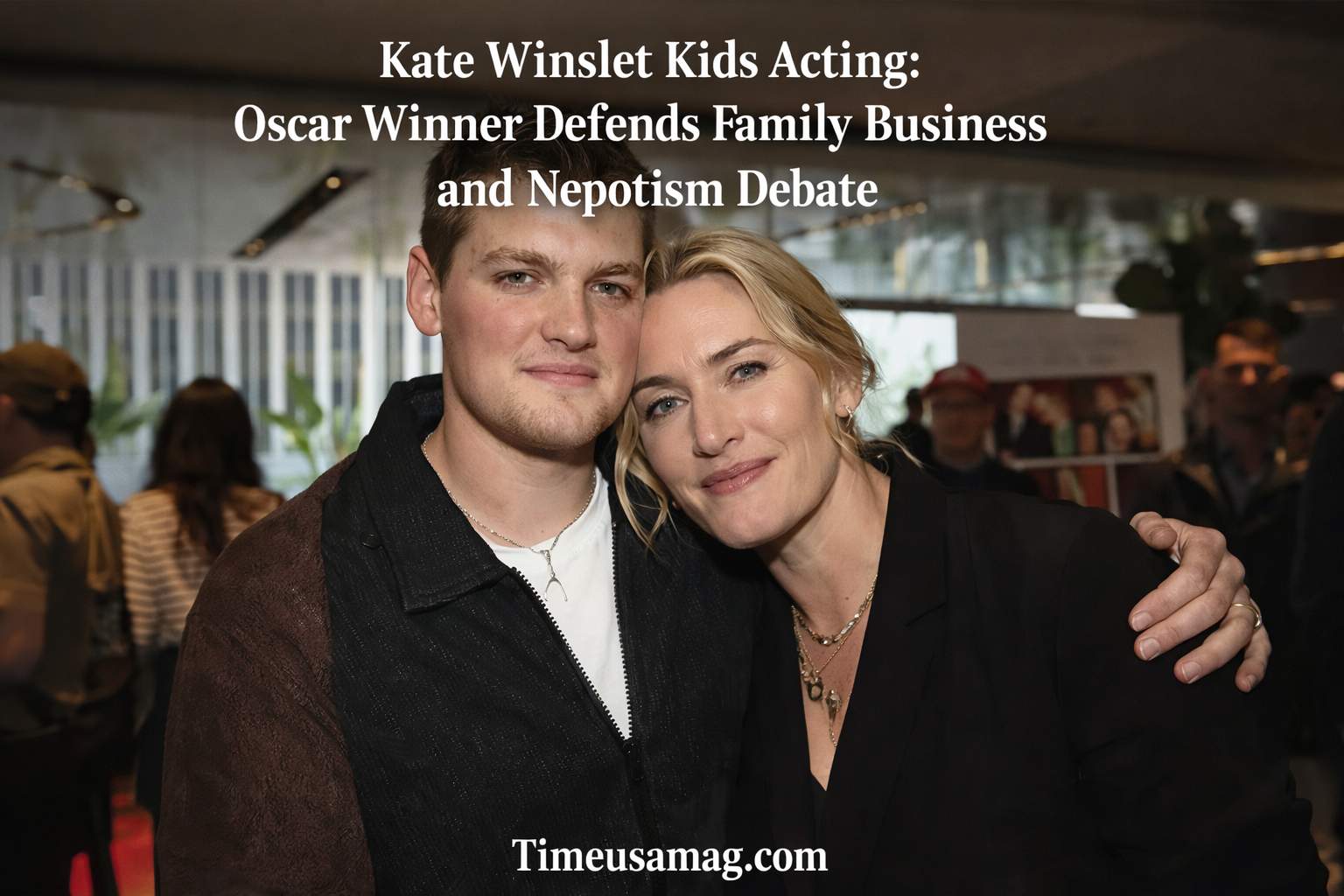
Kate Winslet supports her kids acting careers, defends against nepotism criticism. Discover how Mia Threapleton and Joe Anders built their own Hollywood paths.
Kate Winslet has emerged as a vocal defender of her children pursuing acting careers, pushing back firmly against “nepo baby” criticism while celebrating her kids’ independent achievements in Hollywood’s competitive landscape. The Oscar-winning actress recently directed her first film, “Goodbye June,” written by her 21-year-old son Joe Anders, while daughter Mia Threapleton, 25, continues building an impressive acting resume that includes leading a Wes Anderson film.
Kate Winslet Kids Acting: Supporting the Family Business
Having worked steadily in Hollywood for three decades, few actors understand the entertainment industry’s pressures, challenges, and opportunities better than Kate Winslet, 50. This extensive experience informs her approach to her own children’s career choices, which she has never discouraged despite the intense scrutiny facing celebrity offspring in the arts.
Winslet’s family represents multiple generations of entertainment industry involvement. Her daughter Mia Threapleton has appeared in British anthology series “I Am…” alongside her mother and led Wes Anderson’s “The Phoenician Scheme” this past summer. Her son Joe Anders wrote and inspired “Goodbye June,” which Winslet directed for Netflix, marking her directorial debut. She also has a 12-year-old son, Bear, with husband Edward Abel Smith.
Rather than steering her children away from the industry that shaped her life, Winslet has chosen to equip them with values, work ethic, and realistic expectations about what building an acting career truly requires.
“Part of mothering is learning to let go,” Winslet explains, acknowledging the difficulty of watching children navigate an industry known for rejection, criticism, and intense public scrutiny. Her parenting philosophy emphasizes preparation over protection, giving her children tools to succeed rather than attempting to shield them from challenges.
Addressing the Nepotism Debate Head-On
Kate Winslet doesn’t shy away from the “nepo baby” conversation—the contemporary term for celebrity children whose family connections provide industry access unavailable to most aspiring performers. Instead of avoiding the topic, she confronts it directly while defending her children’s legitimate achievements.
“What I’ve only ever tried to do is to reinforce to my children how important it is to work for things, to strive for something, and not to listen to the f—— nepo baby thing, because it’s not actually very nice or even kind,” Winslet states with characteristic forthrightness.
Her passionate response reflects frustration with how the nepotism debate often dismisses individual merit and hard work. While acknowledging that family connections can open doors, Winslet argues that maintaining a career requires talent, dedication, and professionalism that no family name can provide.
“People have been going into family businesses for years and years,” she continues, placing entertainment industry dynasties within the broader context of families working together across all professional fields. “For example, I’ve never met Wes Anderson. Never in my life, not once. So it’s really not cool to use that term in any context to do with Mia because she’s done it all herself.”
This specific example—Mia leading a Wes Anderson film without Kate ever having met the acclaimed director—demonstrates that talent and professionalism earn roles, not merely family surnames. Anderson cast Mia based on her abilities and audition, not her famous mother’s connections.
Mia Threapleton’s Independent Path to Acting
The Kate Winslet kids acting story reveals careful parenting designed to help children develop independence rather than relying on maternal fame. Mia Threapleton’s journey into acting demonstrates the deliberate separation Winslet maintained between family life and professional work.
Speaking to USA TODAY earlier in 2025, Threapleton shared revealing details about her path to acting. As a teenager, she signed up to casting websites without her mother’s knowledge, actively pursuing opportunities rather than waiting for Kate to make introductions or secure auditions.
“My mum really kept it very separate,” Threapleton explained in June 2025. “Home was home, and work was work.”
This separation meant Mia spent minimal time on film sets as a child, avoiding the trap of viewing Hollywood as her natural playground rather than a professional workspace requiring serious preparation. By keeping her daughter away from sets, Winslet ensured Mia developed a normal childhood rather than one defined by celebrity and film production.
When Mia decided to pursue acting, she did so with realistic understanding of the industry’s demands rather than romanticized notions formed from childhood set visits. This grounded perspective has served her well as she builds a career based on merit rather than merely capitalizing on her mother’s fame.
The 25-year-old actress has steadily accumulated credits demonstrating range and commitment. Her appearance in “I Am…” alongside Kate marked one of their few professional collaborations—a project where their shared work enhanced rather than defined the production.
Her role leading Wes Anderson’s “The Phoenician Scheme” represents a significant career milestone. Anderson, known for his meticulous casting and distinctive directorial vision, selected Mia based on her audition and fit for the character. That Kate Winslet has never met Anderson underscores that this casting decision involved zero maternal influence.
Kate Winslet’s Parenting Philosophy for Industry Kids
Beyond addressing nepotism criticisms, Kate Winslet articulates a clear philosophy about preparing children for entertainment careers:
“Mia is a very evolved, resilient young woman, so I don’t actually worry about Mia in any way,” Winslet says with evident maternal pride. “And I don’t worry about Joe, either. Both my kids care about doing a good job. But more importantly, they care very much about being good people, and that’s the only thing I’ve ever said to them: Just be a decent person, don’t complain. If you need to complain, phone me, phone each other, learn your lines, do the work, and be ready. That’s as much as you can ever do.”
This practical advice emphasizes several key principles:
Character before career: Winslet prioritizes her children being “good people” over being successful actors. This values hierarchy ensures that even if acting careers don’t work out, Mia and Joe possess the character traits necessary for fulfilling lives.
Work ethic over talent: The instruction to “learn your lines, do the work, and be ready” emphasizes preparation and professionalism. Natural talent might open initial doors, but sustained careers require consistent hard work that no family connection can substitute.
Private complaints, public professionalism: The advice to “phone me, phone each other” rather than complaining publicly teaches appropriate boundaries. The entertainment industry requires gracious professionalism even when facing difficult circumstances.
Personal responsibility: By telling her children “that’s as much as you can ever do,” Winslet acknowledges that preparation and professionalism don’t guarantee success. This realistic perspective helps her children manage disappointment without internalizing rejection as personal failure.
These principles apply broadly beyond the entertainment industry, representing sound parenting for any profession. Winslet’s approach combines practical career advice with character development, ensuring her children succeed as humans regardless of professional outcomes.
Joe Anders: From College Exercise to Netflix Feature
Joe Anders’ journey to writing “Goodbye June” illustrates how talent emerges through dedication rather than merely trading on family connections. The 21-year-old didn’t set out to write a major Netflix feature—he began as a college student completing a class assignment.
Anders started writing what became “Goodbye June” as an exercise for a college screenwriting class, using the project to process grief and explore family dynamics. The screenplay drew inspiration from the 2017 death of Kate Winslet’s mother, making the project deeply personal for the entire family.
The tearjerking drama follows an ailing matriarch named June (played by Helen Mirren) whose family gathers at her hospital bedside in the weeks leading up to Christmas. The story explores how families navigate impending loss, celebrate shared memories, and find ways to say goodbye when time runs short.
That Anders transformed a student exercise into a screenplay compelling enough to attract Helen Mirren and earn Netflix distribution speaks to genuine writing talent. While his famous parents—Kate Winslet and director Sam Mendes—surely provided industry insights, they couldn’t write the screenplay for him or guarantee its quality.
Like his sister Mia, Joe has built an acting career alongside his writing. He appeared in “Lee” starring his mother Kate Winslet, as well as in the Oscar-winning “1917” directed by his father Sam Mendes. These family collaborations represent natural professional intersections rather than nepotistic casting—both films benefited from Joe’s performances rather than merely accommodating a famous person’s child.
Anders’ upcoming projects include Netflix series “East of Eden” alongside Florence Pugh and Apple TV’s “Cape Fear” opposite Javier Bardem and Amy Adams. These high-profile bookings suggest casting directors and producers view him as a talented performer rather than merely Kate Winslet’s son.
Goodbye June: Kate Winslet’s Directorial Debut
“Goodbye June,” streaming December 24, 2025 on Netflix, marks Kate Winslet’s first directorial effort—a significant career expansion for an actress who has spent three decades in front of cameras. Her decision to direct her son’s screenplay creates a unique mother-son collaboration celebrating family bonds while honoring the memory of Winslet’s late mother.
The film stars Helen Mirren in the title role, with Andrea Riseborough among the supporting cast. Riseborough, Winslet’s friend and frequent collaborator, has known Joe Anders since his teenage years and offers high praise for both his character and his writing.
“He’s very kind, so it wasn’t surprising that he penned the characters with so much generosity and empathy,” Riseborough says about Anders. “But for somebody so young, it was really astounding how he was able to take all these human experiences in, and construct this extraordinary screenplay with so much grace and wisdom. It’s never too technical or dull.”
Riseborough’s comments emphasize what separates nepotism from legitimate family collaboration. Young Anders didn’t write a vanity project trading on his mother’s name—he crafted a screenplay that impressed seasoned professionals like Riseborough on its own merits.
“I have absolutely no right to feel proud of him, but I do!” Riseborough adds, her affection for Anders evident. This sentiment from someone with no familial obligation to praise him validates that his talent earns genuine respect from industry peers.
For Kate Winslet, directing “Goodbye June” allowed her to honor her late mother while supporting her son’s emerging career. The Christmas release timing adds poignancy, as the story explores family gathering during the holiday season to celebrate a matriarch before her passing.
The Broader Nepotism Debate in Hollywood
Kate Winslet’s defense of her children enters a broader conversation about privilege, access, and merit in entertainment. The “nepo baby” discourse has intensified in recent years, with social media amplifying criticism of celebrity children pursuing careers in fields where their parents achieved success.
Critics argue that famous parents’ children enjoy unfair advantages including:
Industry access: Celebrity kids can contact agents, producers, and directors who would ignore unknown aspirants. This access doesn’t guarantee talent but does guarantee opportunities to demonstrate it.
Financial support: Wealthy parents can subsidize years of auditions, acting classes, and unpaid work that aspiring actors from working-class backgrounds cannot afford.
Media attention: Publications cover celebrity offspring’s projects partly due to parental fame, generating publicity that unknown performers must earn through years of work.
Second chances: Famous parents’ children who fail initially often receive additional opportunities that others would never get, allowing them to learn and improve with less pressure.
These advantages are real and significant. However, defenders like Winslet argue that:
Family businesses exist everywhere: Medicine, law, politics, and business all feature dynasties where children follow parents. Entertainment receives disproportionate criticism for a pattern common across professions.
Connections don’t equal talent: Initial opportunities might come through connections, but sustained careers require genuine ability. Audiences quickly reject untalented performers regardless of parentage.
Hard work still matters: Even with advantages, successful performers must learn craft, handle rejection, and maintain professionalism. No family name exempts anyone from these requirements.
Dismissing achievement is unkind: Reducing someone’s accomplishments solely to parental connections ignores their individual effort, talent, and choices.
The debate lacks easy resolution because both perspectives contain truth. Celebrity children do enjoy advantages that create unequal playing fields. Simultaneously, dismissing all their achievements as merely products of nepotism unfairly discounts genuine talent and hard work.
Lessons from Kate Winslet’s Approach
Kate Winslet’s handling of her children’s entertainment careers offers insights for celebrity parents navigating similar situations:
Acknowledge privilege while emphasizing work ethic: Winslet doesn’t pretend her children face the same obstacles as unknown performers. Instead, she emphasizes that their advantages create responsibility to work harder and prove themselves worthy.
Maintain boundaries between family and work: By keeping young Mia away from film sets and allowing her to pursue casting independently, Winslet ensured her daughter developed autonomous identity and realistic industry understanding.
Prioritize character over career: Winslet’s emphasis on her children being “good people” above all else provides grounding beyond professional success or failure.
Support without controlling: “Part of mothering is learning to let go” acknowledges that true support means allowing children to make their own choices and face natural consequences.
Defend your children while acknowledging nuance: Winslet pushes back against nepotism criticism without claiming her children face no advantages. This balanced approach validates their achievements while recognizing complex realities.
The Future for Winslet’s Children
As Mia Threapleton, 25, and Joe Anders, 21, continue building their careers, they carry both the advantages and burdens of famous parentage. Their success will depend partly on talent and partly on how they navigate the unique pressures facing celebrity offspring.
Mia’s landing the lead in a Wes Anderson film without Kate ever meeting the director suggests she’s successfully establishing independent credibility. Her continued work will demonstrate whether this represents sustainable career trajectory or merely promising beginning.
Joe’s transformation from student screenwriter to Netflix feature writer indicates genuine writing talent. His upcoming acting roles in high-profile series suggest he’s also building legitimate performing career. Time will reveal whether he pursues acting, writing, directing, or some combination.
The youngest Winslet child, 12-year-old Bear, may or may not eventually pursue entertainment careers. If he does, he’ll benefit from siblings who’ve navigated the path before him and a mother whose experience grows deeper each year.
Conclusion: Beyond the Nepotism Debate
Kate Winslet’s passionate defense of her kids acting careers challenges simplistic narratives about nepotism in Hollywood. Her children clearly benefit from advantages unavailable to most aspiring performers. Simultaneously, they’ve demonstrated work ethic, talent, and independent achievement that deserve recognition beyond mere family connections.
The “nepo baby” conversation often reduces complex situations to binary judgments—either someone earned everything through pure merit or they achieved nothing beyond parental connections. Reality exists in nuanced middle ground where privilege and talent, advantages and work ethic, all contribute to career outcomes.
Kate Winslet’s approach—acknowledging advantages while emphasizing values, work ethic, and character—offers a model for celebrity parents. Her children’s emerging careers suggest this balanced approach produces young professionals who take their opportunities seriously rather than viewing success as birthright.
As “Goodbye June” debuts on Netflix this Christmas, audiences can judge Joe Anders’ screenplay on its merits while appreciating the unique mother-son collaboration. The film represents both a family honoring their matriarch’s memory and young talent earning professional recognition.
Whether discussing Mia leading a Wes Anderson film or Joe writing a Netflix feature, the Kate Winslet kids acting story ultimately demonstrates that while family connections open doors, walking through them successfully requires genuine ability, dedicated preparation, and professional conduct that no famous parent can provide.
Read More : Rob Reiner Tribute: Billy Crystal and Martin Short Honor Legendary Director After Tragic Death
Read More : William Rush Dies at 31 – Sad News About Waterloo Road Star
Reference By : USATODAY.COM